Trust your gut

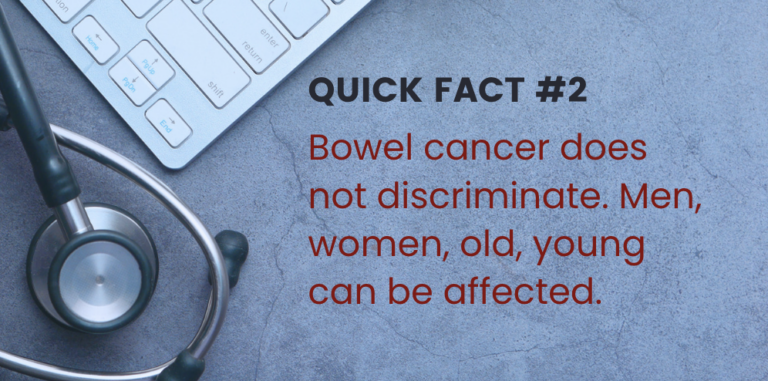
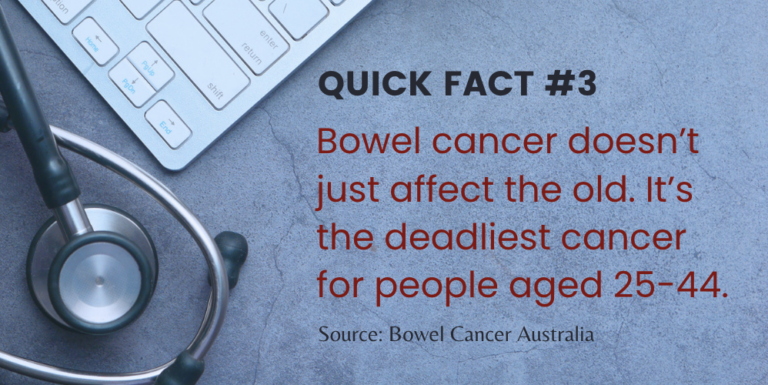
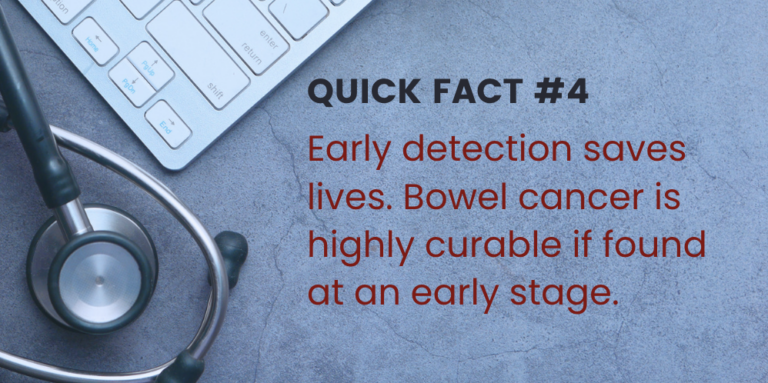
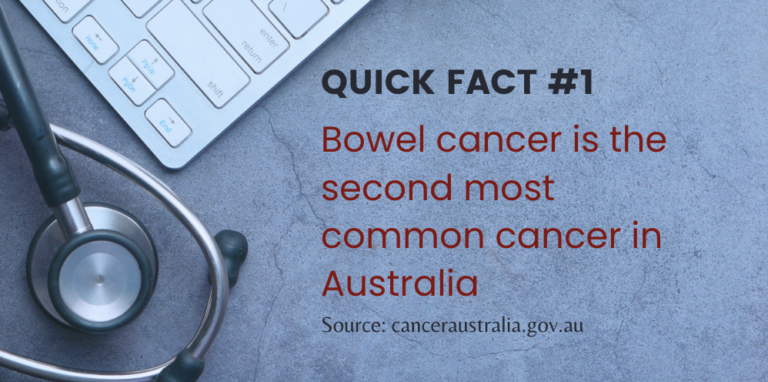
Don’t ignore your symptoms. It may be nothing, but if it’s something more serious, early detection and treatment can save your life.


blood in stool

Bowel cancer is usually a slow-growing cancer. There are often no symptoms in the early stages of the disease. One of the most common symptoms of bowel cancer include blood in the stool. However, many other conditions can cause this symptom, not just bowel cancer. To be sure it’s nothing serious, talk to your GP. Bleeding from the rectum should never be ignored. (Source: Cancer Australia)

 

changes in bowel habits

Symptoms could be a recent, persistent change in bowel habit such as looser, more diarrhoea-like poo, constipation, or going to the toilet more often, or trying to go (irregularity in someone whose bowel habits have previously been regular). A change in shape or appearance of your poo For example, narrower poos than usual or mucus in poo. A feeling that the bowel has not emptied completely after going to the toilet (Source: Bowel Cancer Australia)

 

abdominal pain

Abdominal pain or swelling; pain or a lump in the anus or rectum; frequent gas pain, cramps; a feeling of fullness or bloating in the bowel or rectum. Not everyone experiences symptoms, particularly in the early stages of bowel cancer. The above symptoms may be suggestive of bowel cancer, but they can also be due to other medical conditions, some foods or medicines. (Source: Bowel Cancer Australia)

 

dysphagia

Difficulty swallowing or dysphagia could be a symptom of many different medical conditions. Minor issues could prevent the oesophagus or throat from working properly. But it could also be a symptom of something more serious such as oesophageal cancer. If you are experiencing this, talk to your GP.

Coming soon
The ‘Lifestyle’ Variable: There IS something YOU can do

TAKING CONTROL OF YOUR HEALTH

Endoscopic screening and adherence to a healthy lifestyle are major avenues for bowel cancer / colorectal cancer prevention.

Focus on what you can control to minimise your risk factors.

life coach woman figure img
01.

Healthy eating habits

When it comes to colon cancer, one of the best things you can do to reduce your risk is to pay closer attention to your diet. While there is no guaranteed way to completely prevent colon cancer, there are certain dietary strategies that can help reduce your risk.

02.

Regular Exercise

The Cancer Institute recommends one hour of moderate activity or 30 minutes of vigorous activity every day to help reduce your cancer risk and live a healthier life. Regardless of how old you are, the more you move, the better.

03.

Good sleep habits

According to John Hopkins Medicine, disruptions in the body’s “biological clock,” which controls sleep and thousands of other functions, may raise the odds of cancers of the breast, colon, ovaries and prostate.

04.

Maintaining healthy BMI

Did you know that being overweight significantly increases your risk of 13 different types of cancer?
Evidence now shows that being overweight or obese is the cause for nearly 5,300 cancer cases in Australia each year. (Source: Cancer Council)

05.

Not smoking and limiting alcohol intake

Bowel cancer risk increases significantly when two or more alcoholic drinks are consumed per day.  Smoking 40 cigarettes (two packs) per day increases the risk of bowel cancer by around 40% and nearly doubles the risk of bowel cancer death.

06.

Be proactive in your healthcare

If detected early, bowel cancer can be successfully treated in more than 90% of casesEarlier diagnosis also means treatment can be less invasive. Empower yourself with knowledge. Learn more about why screening saves lives.

Frequently ASKED QUESTIONS

FAQs

At what age should I start bowel cancer screening in Australia?

Screening is recommended from age 45. Since 1 July 2024, the National Bowel Cancer Screening Program covers everyone aged 45 to 74. If you’re 45 to 49 you can request your first free home test kit; if you’re 50 to 74 a kit is mailed to you automatically every two years. You can request a kit, or check when your next one is due, through the National Cancer Screening Register on 1800 627 701 or at health.gov.au/nbcsp. Bowel cancer often develops with no symptoms at all, which is why screening at the recommended age matters even when you feel well.

The home test looks for hidden blood; a colonoscopy looks directly inside the bowel. The national screening kit is an immunochemical faecal occult blood test (iFOBT/FIT). It’s a simple test you do at home that detects tiny amounts of blood in your stool that are not visible to the eye. It’s the right first step for people at average risk and no symptoms. But if you have already seen blood with the naked eye or have other symptoms, talk to your GP about a colonoscopy. A colonoscopy is a procedure performed by a specialist that allows the bowel lining to be examined directly and any polyps removed in the same session. This reduces your future bowel cancer risk. A positive home test, having symptoms, or a significant family history are the usual reasons a colonoscopy is recommended.

A positive result means blood was detected, which needs follow-up. It does not, on its own, mean you have cancer. Blood in the stool has several possible causes, and the purpose of the next step is to find out which one applies to you. The recommended follow-up after a positive iFOBT is a colonoscopy, usually arranged through your GP’s referral to a gastroenterologist. Acting on a positive result promptly is the single most useful thing you can do, because it’s how early, treatable changes are found.

Yes. Some symptoms warrant seeing a doctor rather than waiting for a routine kit. Screening is for people without symptoms. If you notice persistent changes such as blood in your stool, a lasting change in bowel habit, unexplained weight loss, ongoing abdominal pain, or unexplained tiredness that could point to low iron, it’s worth seeing your GP promptly. These may have a benign explanation, but they should be assessed rather than monitored at home.

Possibly. A family history can mean screening should start earlier or use a colonoscopy rather than the home test. The national program is designed for people at average risk. If a parent, sibling or child has had bowel cancer or polyps, particularly at a younger age, your own risk may be higher, and a different screening schedule may be appropriate. This is worth discussing with your GP or with us, so the timing and type of screening can be matched to your individual history.

A colonoscopy is a day procedure, usually performed under sedation, so most people are comfortable and remember little of it. A thin, flexible camera is used to examine the lining of the large bowel, and any polyps found can typically be removed at the same time. The procedure itself usually takes around 20 to 40 minutes, though you’ll be at the facility for several hours allowing for preparation and recovery. We’ll talk through exactly what to expect before the day.

They sound similar but are different conditions. IBS (irritable bowel syndrome) is a disorder of how the gut functions. It causes real and often distressing symptoms such as pain, bloating and altered bowel habits, but it doesn’t damage the bowel. IBD (inflammatory bowel disease), which includes Crohn’s disease and ulcerative colitis, involves actual inflammation that can damage the bowel and needs ongoing medical management. Because the symptoms overlap, testing is sometimes needed to tell them apart, and the treatment approaches are quite different.

Advanced or interventional endoscopy is a group of specialised techniques that can treat some conditions endoscopically, where open or keyhole surgery was once the only route. Using a flexible camera passed through the mouth or bowel, a trained specialist can remove certain growths, open narrowed areas, place stents, or examine and treat the bile and pancreatic ducts without external incisions. Whether one of these approaches is suitable depends on the specific condition and is assessed case by case.

The decision depends on your individual situation, chiefly the nature of the lesion and how early it is, and it is made through assessment rather than as a blanket rule. Factors such as the size, depth, location and pathology of a lesion all influence whether it can be treated endoscopically or is better managed with surgery. In many cases the options are weighed together, often with input from a surgeon, so the approach chosen is the one best suited to you. For some patients, this includes presenting their case at a multidisciplinary team (MDT) meeting, where gastroenterologists, surgeons, radiologists, pathologists and other specialists review the findings together and agree on the most appropriate approach. Dr Keegan works closely with surgical colleagues, so where more than one option exists, the recommendation reflects that combined expertise rather than a single viewpoint. The aim is the safest, most effective treatment for your circumstances, rather than a single method applied to everyone.

Request an Appointment

Please note: a doctor's referral is needed to make an appointment.