- What is your doctor's Adenoma Detection Rate (ADR)?
- What about Average Withdrawal Time?
- GIE Journal: Quality in Endoscopy Metrics & Benchmarks
- Rethinking Post-colonoscopy Colorectal Cancer Risk: Endoscopist Performance Versus Presence of High-risk Polyps
 What is your doctor’s Adenoma Detection Rate (ADR) and why should you care?
Although gastroenterologists undergo the most extensive training in performing colonoscopies, their rates of polyp detection can vary significantly. When interviewing gastroenterologists to perform your procedure, look for a physician with an ADR of at least 25 percent in men and 15 percent in women. The higher the ADR, the better.
Research shows that for every 1% increase in a physician’s ADR, your risk of developing colon cancer over the next year decreases by 3%, and a 5% decrease in risk of a fatal interval cancer.
Conclusions of this study: the adenoma detection rate was inversely associated with the risks of interval colorectal cancer, advanced-stage interval cancer, and fatal interval cancer.
— Source: https://www.ncbi.nlm.nih.gov/pmc/articles/PMC5723728/#r7
 What else should you ask your doctor?
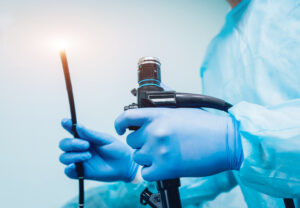
You may feel a little uneasy asking your potential doctor about providing an ADR, but rest assured that this is a reasonable request. Qualified gastroenterologists take pride in their hard-earned ADRs, and they will be happy to share this information with you. You should also enquire about your physician’s average withdrawal time, which is the amount of time it takes to remove the scope from the colon. You want a gastroenterologist with an average withdrawal time of at least six minutes.
Finding the right gastroenterologist may require a bit of courage and assertiveness, but it is well worth the effort. Make a list of questions to ask when interviewing potential physicians, and be sure to include ADR and average withdrawal time. A high-quality physician is the key to a thorough examination and a future without colon cancer.
Why is the Average Withdrawal Time important?
Adenoma detection was strongly associated with longer withdrawal times: endoscopists whose withdrawal times were more than 6 minutes detected more than twice as many patients with adenomas that were 1cm or larger in size.
(Source: https://www.ncbi.nlm.nih.gov/pmc/articles/PMC3099297/)
Clinical Gastroenterology and Hepatology
Background and Aims
Methods
Results
Conclusions